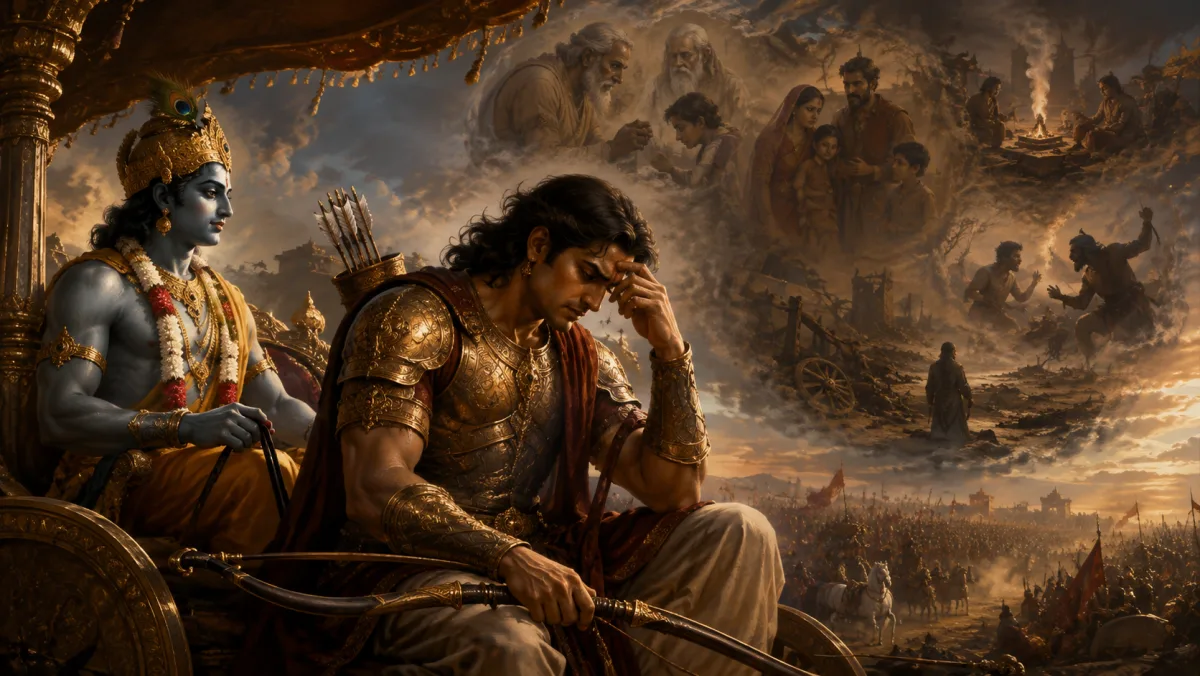
Arjuna's Concerns: A 5,000-Year Sociological Thesis
Unpacking the True Cost of War on Family, Tradition, and Sanatana Dharma.
By Alok Mani Tripathi | | 8 Min Read
When we picture the battlefield of Kurukshetra, we imagine clashing swords and blowing conch shells. But before a single arrow was fired, the greatest archer of the age dropped his weapon. Arjuna's reluctance to fight in the first chapter of the Bhagavad Gita is often misunderstood as mere sentimentality or fear.
Read closely, and it reveals something far deeper. Arjuna was acting as a visionary sociologist. Addressing Lord Krishna, he outlined a terrifyingly accurate domino effect: how a massive war would wipe out the leadership, fracture the family unit, and plunge society into generational chaos. Looking at Bharat (India) today, five thousand years later, we must ask: Was Arjuna right?
1. The Collapse of the Family Foundation
Arjuna's first major concern addressed to Krishna was the destruction of the foundational unit of society: the family.
"With the destruction of dynasty, the eternal family tradition is vanquished, and thus the rest of the family becomes involved in irreligion."
Arjuna foresaw that when the elders—the carriers of wisdom—are wiped out, the chain of transmission breaks. We see the echoes of this today in the collapse of the traditional Indian joint family. Rapid urbanization and the pursuit of material survival have left the younger generations physically and culturally separated from their elders. Without this organic transfer of values, the youth are left without a spiritual compass, exactly as Arjuna predicted.
2. The Rise of an Unanchored Generation
Arjuna then issues his most chilling warning about the sociological aftermath of a broken society:
"When irreligion is prominent in the family, O Krishna, the women of the family become polluted, and from the degradation of womanhood comes unwanted progeny (varna-sankara)."
We must translate Arjuna's ancient phrasing into today's context. Varna-sankara here represents a generation born into instability. Today, it mirrors the hyper-individualism and fractured family dynamics of the 21st century. When society prioritizes extreme corporate competition over nurturing families, it creates an "unwanted" situation: a highly educated but spiritually adrift generation. They inherit the trauma of a disconnected society, lacking the moral anchoring that traditional institutions once provided.
3. The Severing of Roots and Community Welfare
Arjuna points out that this decay does not just affect the living; it cuts society off from its past and its future.
"O Janardana, I have heard from the disciplic succession that those who destroy family traditions dwell always in hell."
The "hell" Arjuna speaks of is the chaos of a society that has forgotten its identity. The centuries following the Mahabharata saw this play out. The fluid, action-based Varna system rigidified into an oppressive, birth-based caste system as society tried to build walls to protect itself. This destroyed internal unity, leaving Bharat vulnerable to centuries of foreign invasions.
The British era weaponized this further by attacking the educational roots, turning ancient history into "mythology" and replacing it with Western paradigms. By the time of independence in 1947, the nation was focused entirely on economic survival, leaving no room to rebuild the spiritual and cultural infrastructure.
4. The Miracle of Survival
If Arjuna's prophecy of destruction came true, how did Sanatana Dharma and Bharat survive at all? Why wasn't it completely erased like the ancient civilizations of Egypt, Greece, or Mesopotamia?
The answer lies in the very nature of what Krishna taught after Arjuna's breakdown. The survival of Bharat was not due to centralized empires, but because of decentralization. The ethics of the Gita, the philosophy of the Vedas, and the stories of the epics were woven into the daily lives, festivals, and folkways of millions of ordinary people.
The civilization survived, but not in its original, pristine form. It survived like a great banyan tree that had its main trunk severed, but whose aerial roots had already dug deep into the soil.
From Survival to Revival
Arjuna's tears on the chariot were justified. The Kurukshetra war did trigger a civilizational bottleneck. For the next five millennia, Bharat went into "survival mode." To protect itself from invasions and colonial erasure, society built hard shells around its traditions, prioritizing rigid adherence over deep understanding. We survived, but the profound intellectual and spiritual core was buried under rote rituals.
Today, in the 21st century, we are looking at the remnants of that survival strategy. We have a young generation that observes the outer shell of these rituals, finds them empty, and naturally walks away. They are not to blame; the chain of transmission was broken long before they were born.
But recognizing this history is not a reason for despair—it is a call to action. We can no longer afford to just "survive." The responsibility to rebuild the bridge Arjuna saw collapsing falls entirely on us.
We cannot wait for the education system or the government to teach Vedic philosophy to our children. It must start in our own homes. It starts by answering the "why" behind our traditions, rather than just enforcing the "how." It requires us to study the Gita not as a religious relic, but as a manual for psychological resilience and ethical living, and to translate that into the modern language our youth speak.
Krishna did not tell Arjuna that society wouldn't break; He told him that he still had to stand up and do his duty (Dharma) amidst the chaos. Our modern Kurukshetra is not fought with arrows, but with knowledge, patience, and dialogue. To save the future of this civilization, we must step up and become the very elders Arjuna feared losing.
Share this post
दर्शन (Philosophy)
अर्जुन की चिंताएँ: 5,000 साल पुराना एक समाजशास्त्रीय शोध
परिवार, परंपरा और सनातन धर्म पर युद्ध की वास्तविक कीमत का विश्लेषण।
आलोक मणि त्रिपाठी द्वारा | | पढ़ने में ८ मिनट
जब हम कुरुक्षेत्र के युद्धक्षेत्र की कल्पना करते हैं, तो हमारे मन में तलवारों के टकराने और शंख बजने की छवि उभरती है। लेकिन एक भी तीर चलने से पहले, उस युग के सर्वश्रेष्ठ धनुर्धर ने अपने हथियार डाल दिए थे। भगवद्गीता के पहले अध्याय में अर्जुन के युद्ध करने की अनिच्छा को अक्सर केवल भावुकता या भय के रूप में गलत समझा जाता है।
इसे ध्यान से पढ़ें, तो कुछ बहुत गहरा अर्थ सामने आता है। अर्जुन एक दूरदर्शी समाजशास्त्री के रूप में कार्य कर रहे थे। भगवान कृष्ण को संबोधित करते हुए, उन्होंने एक भयानक रूप से सटीक डोमिनोज़ प्रभाव (श्रृंखला प्रतिक्रिया) की रूपरेखा प्रस्तुत की: कैसे एक विशाल युद्ध नेतृत्व को खत्म कर देगा, परिवार की इकाई को तोड़ देगा, और समाज को पीढ़ियों तक अराजकता में धकेल देगा। आज, पाँच हज़ार साल बाद, भारत को देखते हुए हमें खुद से पूछना चाहिए: क्या अर्जुन सही थे?
1. पारिवारिक नींव का पतन
कृष्ण से व्यक्त की गई अर्जुन की पहली बड़ी चिंता समाज की मूलभूत इकाई: 'परिवार' के विनाश को लेकर थी।
"कुल का नाश होने पर सनातन कुल-धर्म नष्ट हो जाते हैं, और धर्म के नष्ट हो जाने पर संपूर्ण कुल में पाप बहुत फैल जाता है।"
अर्जुन ने यह पहले ही देख लिया था कि जब घर के बड़े-बुजुर्ग—जो ज्ञान के वाहक होते हैं—नष्ट हो जाते हैं, तो ज्ञान के हस्तांतरण की श्रृंखला टूट जाती है। आज हम पारंपरिक भारतीय संयुक्त परिवार के पतन में इसी की प्रतिध्वनि देखते हैं। तेजी से हो रहे शहरीकरण और भौतिक उत्तरजीविता की दौड़ ने युवा पीढ़ियों को शारीरिक और सांस्कृतिक रूप से अपने बुजुर्गों से अलग कर दिया है। मूल्यों के इस जैविक हस्तांतरण के बिना, युवा एक आध्यात्मिक दिशा-सूचक (spiritual compass) के बिना रह गए हैं, ठीक वैसे ही जैसे अर्जुन ने भविष्यवाणी की थी।
2. एक दिशाहीन पीढ़ी का उदय
इसके बाद अर्जुन एक टूटे हुए समाज के समाजशास्त्रीय परिणामों के बारे में अपनी सबसे डरावनी चेतावनी जारी करते हैं:
"हे कृष्ण! पाप के अधिक बढ़ जाने से कुल की स्त्रियां अत्यंत दूषित हो जाती हैं; और हे वार्ष्णेय! स्त्रियों के दूषित हो जाने पर अवांछित संतान (वर्णसंकर) उत्पन्न होती है।"
हमें अर्जुन के प्राचीन शब्दों को आज के संदर्भ में समझना होगा। यहाँ वर्णसंकर अस्थिरता में पैदा हुई पीढ़ी का प्रतिनिधित्व करता है। आज, यह 21वीं सदी के अति-व्यक्तिवाद (hyper-individualism) और खंडित पारिवारिक गतिशीलता को दर्शाता है। जब समाज परिवारों को पोषित करने की तुलना में अत्यधिक कॉर्पोरेट प्रतिस्पर्धा को प्राथमिकता देता है, तो यह एक "अवांछित" स्थिति पैदा करता है: एक उच्च शिक्षित लेकिन आध्यात्मिक रूप से दिशाहीन पीढ़ी। उन्हें एक असंबद्ध समाज का आघात विरासत में मिलता है, जिसमें उस नैतिक आधार की कमी होती है जो पारंपरिक संस्थाएं कभी प्रदान करती थीं।
3. जड़ों का कटना और सामुदायिक कल्याण
अर्जुन यह भी बताते हैं कि यह पतन न केवल जीवित लोगों को प्रभावित करता है; बल्कि यह समाज को उसके अतीत और भविष्य से भी काट देता है।
"हे जनार्दन! मैंने गुरु-शिष्य परंपरा से सुना है कि जो लोग कुल-धर्म को नष्ट करते हैं, वे हमेशा नरक में वास करते हैं।"
अर्जुन जिस "नरक" की बात करते हैं, वह उस समाज की अराजकता है जो अपनी पहचान भूल चुका है। महाभारत के बाद की सदियों में हमने यह देखा। जब समाज ने खुद को बचाने के लिए दीवारें बनाने की कोशिश की, तो एक समय की लचीली, कर्म-आधारित वर्ण व्यवस्था एक दमनकारी, जन्म-आधारित जाति व्यवस्था में कठोर हो गई। इसने आंतरिक एकता को नष्ट कर दिया, जिससे भारत सदियों तक विदेशी आक्रमणों के प्रति संवेदनशील हो गया।
ब्रिटिश काल ने शैक्षिक जड़ों पर हमला करके इसे और भी खतरनाक बना दिया, प्राचीन इतिहास को "पौराणिक कथाओं" में बदल दिया और इसे पश्चिमी दृष्टिकोण से प्रतिस्थापित कर दिया। 1947 में स्वतंत्रता मिलने तक, राष्ट्र पूरी तरह से आर्थिक उत्तरजीविता पर केंद्रित था, जिससे आध्यात्मिक और सांस्कृतिक बुनियादी ढांचे के पुनर्निर्माण के लिए कोई जगह नहीं बची।
4. अस्तित्व का चमत्कार
यदि विनाश की अर्जुन की भविष्यवाणी सच हुई, तो सनातन धर्म और भारत कैसे बचे रहे? प्राचीन मिस्र, यूनान या मेसोपोटामिया की सभ्यताओं की तरह यह पूरी तरह से क्यों नहीं मिट गया?
इसका उत्तर इस बात में निहित है कि अर्जुन के टूटने के बाद कृष्ण ने क्या सिखाया। भारत का अस्तित्व केंद्रीकृत साम्राज्यों के कारण नहीं, बल्कि विकेंद्रीकरण (decentralization) के कारण बचा रहा। गीता की नैतिकता, वेदों का दर्शन, और महाकाव्यों की कहानियाँ लाखों आम लोगों के दैनिक जीवन, त्योहारों और लोक परंपराओं में बुनी गई थीं।
यह सभ्यता बची रही, लेकिन अपने मूल, प्राचीन रूप में नहीं। यह उस विशाल बरगद के पेड़ की तरह बची रही जिसका मुख्य तना तो काट दिया गया हो, लेकिन जिसकी हवाई जड़ें पहले ही मिट्टी में गहराई तक जा चुकी थीं।
अस्तित्व से पुनरुत्थान की ओर: वो बुजुर्ग बनें जिन्हें हमने खो दिया
रथ पर अर्जुन के आँसू जायज थे। कुरुक्षेत्र के युद्ध ने वास्तव में एक सभ्यतागत संकट को जन्म दिया। अगले पाँच सहस्राब्दियों तक, भारत "सर्वाइवल मोड (बचने की मुद्रा)" में चला गया। आक्रमणों और औपनिवेशिक मिटावट से खुद को बचाने के लिए, समाज ने अपनी परंपराओं के चारों ओर कठोर आवरण बना लिए, गहरी समझ के बजाय कठोर पालन को प्राथमिकता दी। हम बच गए, लेकिन गहरा बौद्धिक और आध्यात्मिक मूल रटे-रटाए कर्मकांडों के नीचे दब गया।
आज, 21वीं सदी में, हम उस सर्वाइवल रणनीति के अवशेषों को देख रहे हैं। हमारे पास एक युवा पीढ़ी है जो इन कर्मकांडों के बाहरी आवरण को देखती है, उन्हें खाली पाती है, और स्वाभाविक रूप से दूर चली जाती है। इसमें उनकी कोई गलती नहीं है; उनके पैदा होने से बहुत पहले ही ज्ञान के हस्तांतरण की श्रृंखला टूट चुकी थी।
लेकिन इस इतिहास को पहचानना निराशा का कारण नहीं है—यह कार्रवाई का आह्वान है। अब हम केवल "बचे रहने" का जोखिम नहीं उठा सकते। अर्जुन ने जिस पुल को ढहते हुए देखा था, उसके पुनर्निर्माण की जिम्मेदारी पूरी तरह से हम पर है।
हम अपने बच्चों को वैदिक दर्शन पढ़ाने के लिए शिक्षा प्रणाली या सरकार का इंतजार नहीं कर सकते। इसकी शुरुआत हमारे अपने घरों से होनी चाहिए। इसकी शुरुआत हमारी परंपराओं के पीछे के "क्यों" का उत्तर देने से होती है, न कि केवल "कैसे" को लागू करने से। इसके लिए हमें गीता का अध्ययन एक धार्मिक अवशेष के रूप में नहीं, बल्कि मनोवैज्ञानिक लचीलेपन और नैतिक जीवन के लिए एक नियमावली (manual) के रूप में करने की आवश्यकता है, और इसे उस आधुनिक भाषा में अनुवाद करने की आवश्यकता है जो हमारे युवा बोलते हैं।
कृष्ण ने अर्जुन से यह नहीं कहा कि समाज नहीं टूटेगा; उन्होंने उससे कहा कि उसे अराजकता के बीच भी खड़े होकर अपना कर्तव्य (धर्म) निभाना होगा। हमारा आधुनिक कुरुक्षेत्र तीरों से नहीं, बल्कि ज्ञान, धैर्य और संवाद से लड़ा जाना है। इस सभ्यता के भविष्य को बचाने के लिए, हमें आगे आना होगा और वही बुजुर्ग बनना होगा जिन्हें खोने का डर अर्जुन को था।