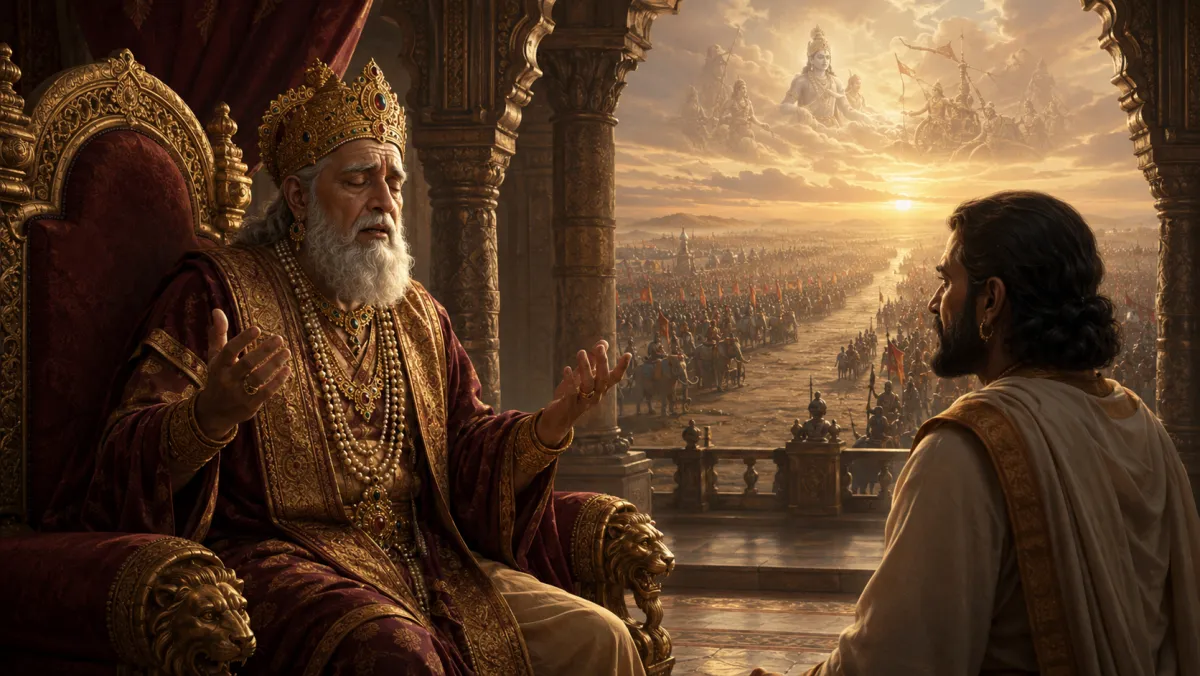
When we read the opening of the Bhagavad Gita, it is easy to imagine a king simply asking for a battlefield update. But to view it this way is to miss one of the most profound psychological moments in ancient literature.
King Dhritarashtra is not asking for live commentary. He is a traumatized monarch, reeling from catastrophic news, demanding a retrospective Root Cause Analysis (RCA) to understand how his empire's safety net was just destroyed.
To understand the king's mindset, we must first look at the verse itself.
जब हम भगवद्गीता का आरंभ पढ़ते हैं, तो सहज ही लगता है कि एक राजा बस युद्धभूमि का हाल पूछ रहा है। पर इसे इस तरह देखना प्राचीन साहित्य के सबसे गहन मनोवैज्ञानिक क्षणों में से एक को चूक जाना है।
राजा धृतराष्ट्र कोई सीधा प्रसारण नहीं माँग रहे। वे एक आघातग्रस्त सम्राट हैं, विनाशकारी समाचार से हिले हुए, जो एक पूर्वव्यापी मूल-कारण विश्लेषण (Root Cause Analysis) माँग रहे हैं — यह समझने के लिए कि उनके साम्राज्य का सुरक्षा-कवच अभी-अभी कैसे नष्ट हो गया।
राजा की मनःस्थिति समझने के लिए, पहले हमें श्लोक को ही देखना होगा।
धृतराष्ट्र उवाच |
धर्मक्षेत्रे कुरुक्षेत्रे समवेता युयुत्सवः |
मामकाः पाण्डवाश्चैव किमकुर्वत सञ्जय ||
dhṛtarāṣṭra uvāca | dharmakṣetre kurukṣetre samavetā yuyutsavaḥ |
māmakāḥ pāṇḍavāś caiva kimakurvata sañjaya ||
"Dhritarashtra said: O Sanjaya, what did my sons and the sons of Pandu do when they assembled on the holy field of Kurukshetra, eager to fight?"
"धृतराष्ट्र ने कहा: हे संजय! धर्मभूमि कुरुक्षेत्र में युद्ध की इच्छा से एकत्रित हुए मेरे और पांडु के पुत्रों ने क्या किया?"
The Event Flow: The Timeline of a Breakdown
To understand why the King asks this specific question, we must look at the timeline. This verse does not happen on Day 1 of the war. It happens on Day 10.
The war begins. Dhritarashtra relies on his ultimate weapon: the invincible Grandsire Bhishma. As long as Bhishma stands, the King believes his sons cannot lose.
The unthinkable happens. Arjuna strikes down Bhishma. The invincible commander falls upon a bed of arrows.
Sanjaya rushes back to the palace in Hastinapura to deliver this devastating news to the blind King.
Dhritarashtra's carefully constructed mental defenses collapse. Without Bhishma, his sons are doomed.
In a state of shock, the King demands Sanjaya rewind the clock to Day 1 to analyze the initial variables.
Word-by-Word: The Mindset of a Terrified King
Every single word Dhritarashtra chooses is a window into his deep-seated fears, his biases, and his desperate attempt to find the root cause of his disaster.
- धर्मक्षेत्रे — Dharmakṣetre "In the field of Dharma (Righteousness / Duty)" Why he used it: He knows his sons are on the side of Adharma. By naming it a "holy field," he asks: Did the spiritual power of this environment change the outcome?
- कुरुक्षेत्रे — Kurukṣetre "In Kurukshetra (The battlefield)" Why he used it: This establishes the historical and territorial stakes — the ancestral land of the Kurus, the ultimate prize of the dynasty.
- समवेता — Samavetā "Assembled" Why he used it: He pinpoints the exact moment of no return — when both armies locked eyes on the field.
- युयुत्सवः — Yuyutsavaḥ "Eager to fight" Why he used it: He establishes the baseline psychological state — confirming bloodlust was present from the very first second.
- मामकाः & पाण्डवाः — Māmakāḥ & Pāṇḍavāḥ "My sons" & "The sons of Pandu" Why he used it: Here lies the fatal flaw. By splitting the family into "mine" and "theirs," he confesses to the very bias that poisoned his empire.
- किम् अकुर्वत — Kim Akurvata "What did they do" Why he used it: Past tense. He searches for the initial misstep — the exact moment his impossible hopes began to unravel.
Why He Had to Look Back
King Dhritarashtra was physically blind, but his tragedy was his psychological blindness. He spent years ignoring wise counselors, living vicariously through the toxic ambition of his son Duryodhana.
When Bhishma fell on the 10th day, the King's denial was violently stripped away.
He asked, "What did they do when they assembled?" because a man who has just watched his life's work collapse cannot focus on the rubble — he must desperately search the foundation to find the exact crack that brought the whole house down.
घटनाक्रम: एक टूटन की समय-रेखा
यह समझने के लिए कि राजा क्यों यही विशेष प्रश्न पूछते हैं, हमें समय-रेखा देखनी होगी। यह श्लोक युद्ध के पहले दिन का नहीं है। यह दसवें दिन का है।
युद्ध आरंभ होता है। धृतराष्ट्र अपने परम अस्त्र पर निर्भर हैं: अजेय पितामह भीष्म। जब तक भीष्म खड़े हैं, राजा मानते हैं कि उनके पुत्र हार नहीं सकते।
अकल्पनीय घटित होता है। अर्जुन भीष्म को गिरा देते हैं। अजेय सेनापति शरशय्या पर आ गिरते हैं।
संजय हस्तिनापुर के महल में लौटते हैं, अंधे राजा को यह विनाशकारी समाचार सुनाने।
धृतराष्ट्र की सावधानी से गढ़ी गई मानसिक रक्षा-पंक्तियाँ ढह जाती हैं। भीष्म के बिना, उनके पुत्रों का विनाश निश्चित है।
आघात की अवस्था में राजा संजय से माँग करते हैं कि घड़ी को पहले दिन तक पीछे ले जाएँ और आरंभिक कारकों का विश्लेषण करें।
शब्द-दर-शब्द: एक भयभीत राजा का मन
धृतराष्ट्र द्वारा चुना गया हर एक शब्द उनके गहरे भय, उनके पूर्वाग्रह, और अपनी विपत्ति का मूल कारण खोजने के उनके व्यग्र प्रयास की खिड़की है।
- धर्मक्षेत्रे — Dharmakṣetre "धर्म (सत्य / कर्तव्य) के क्षेत्र में" क्यों चुना: वे जानते हैं कि उनके पुत्र अधर्म के पक्ष में हैं। इसे "धर्मभूमि" कहकर वे पूछते हैं: क्या इस भूमि की आध्यात्मिक शक्ति ने परिणाम बदल दिया?
- कुरुक्षेत्रे — Kurukṣetre "कुरुक्षेत्र में (युद्धभूमि)" क्यों चुना: यह ऐतिहासिक और भू-भागीय दाँव तय करता है — कुरुओं की पैतृक भूमि, वंश की परम धरोहर।
- समवेता — Samavetā "एकत्रित" क्यों चुना: वे उस ठीक क्षण को चिह्नित करते हैं जहाँ से लौटना संभव नहीं था — जब दोनों सेनाओं की दृष्टि रणभूमि पर मिली।
- युयुत्सवः — Yuyutsavaḥ "युद्ध के इच्छुक" क्यों चुना: वे आधारभूत मनोदशा स्थापित करते हैं — यह पुष्टि कि रक्तपिपासा पहले ही क्षण से उपस्थित थी।
- मामकाः & पाण्डवाः — Māmakāḥ & Pāṇḍavāḥ "मेरे पुत्र" तथा "पांडु के पुत्र" क्यों चुना: यहीं घातक दोष छिपा है। परिवार को "मेरे" और "उनके" में बाँटकर वे उसी पक्षपात को स्वीकार कर लेते हैं जिसने उनके साम्राज्य को विषाक्त किया।
- किम् अकुर्वत — Kim Akurvata "उन्होंने क्या किया" क्यों चुना: भूतकाल। वे आरंभिक चूक खोज रहे हैं — वह ठीक क्षण जहाँ से उनकी असंभव आशाएँ बिखरने लगीं।
उन्हें पीछे क्यों देखना पड़ा
राजा धृतराष्ट्र शारीरिक रूप से अंधे थे, पर उनकी त्रासदी उनका मनोवैज्ञानिक अंधापन था। उन्होंने वर्षों तक बुद्धिमान मंत्रियों की अनदेखी की, और अपने पुत्र दुर्योधन की विषैली महत्वाकांक्षा के सहारे जीते रहे।
दसवें दिन जब भीष्म गिरे, राजा का आत्म-छल हिंसक रूप से छिन गया।
उन्होंने पूछा, "एकत्रित होकर उन्होंने क्या किया?" — क्योंकि जिस व्यक्ति ने अभी-अभी अपने जीवन भर का कार्य ढहते देखा हो, वह मलबे पर ध्यान नहीं दे सकता; उसे व्यग्रता से नींव खंगालनी होती है, वह ठीक दरार खोजने के लिए जिसने पूरा घर गिरा दिया।