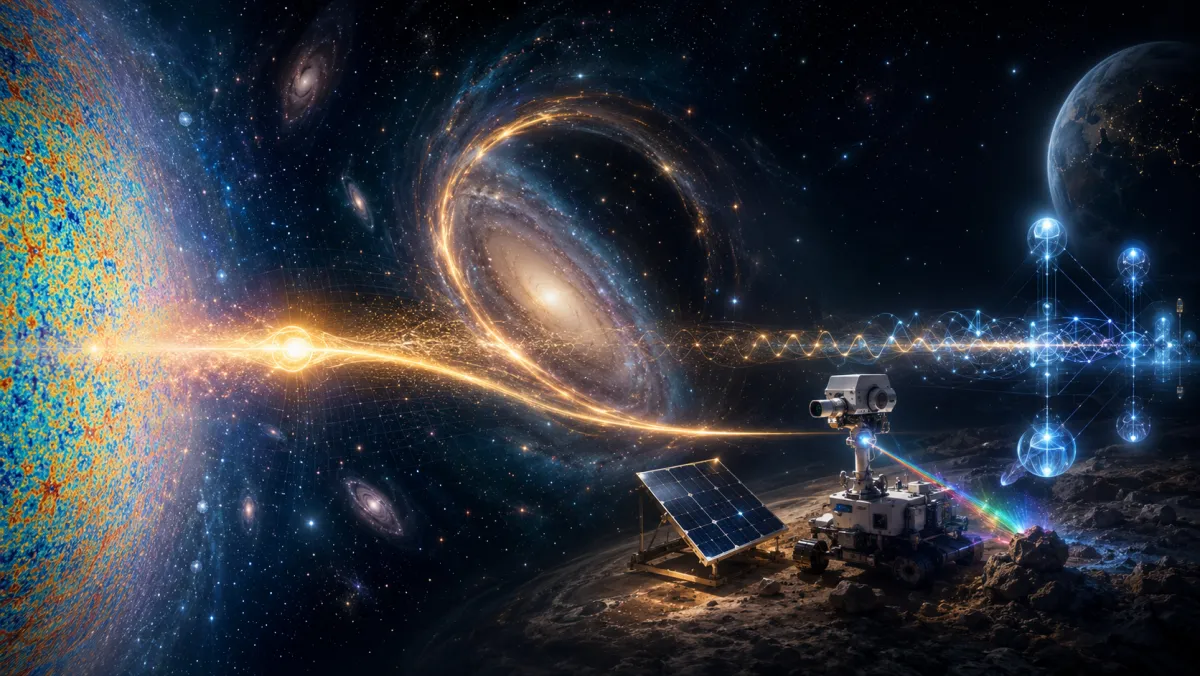
Have you ever stopped to look at a beam of sunlight and wondered what it actually is? Light feels familiar because it is everywhere. It warms our skin, wakes up our mornings, powers plants, and lets our eyes read the world. But when we follow a single particle of light — a photon — deep into modern physics, the familiar becomes extraordinary.
A photon is not just a tiny flash moving through space. It is a quantum messenger. It carries energy without rest mass. It helps us read the chemistry of distant planets. It bends around galaxies. It may even become part of the next generation of secure communication. And, in a poetic way, it also echoes some of humanity's oldest philosophical questions about light, matter, consciousness, and creation.
Box Diagram: One Photon, Many Meanings
This simple map shows the journey we will follow — from cosmic origin to practical technology and philosophical reflection.
1. The 13.8-Billion-Year Road Trip
One of the oldest forms of light we can observe is the cosmic microwave background, often called the afterglow of the Big Bang. These photons were released when the early universe became transparent, hundreds of thousands of years after the Big Bang, and they still fill the sky today as a faint microwave glow.
The mind-bending part is how relativity describes light. A photon has zero rest mass and always travels at the speed of light in vacuum. Along a lightlike path, the proper time is zero. In poetic language, the photon carries the story of 13.8 billion years while having no ticking clock of its own.
Science note: Saying "from the photon's perspective" is a useful metaphor, but not a literal physical frame of reference. The safer statement is: a photon follows a lightlike path where proper time is zero.
2. The Weightless Heavyweight
If a photon has no rest mass, how can it power a solar panel or move an electron? The answer is that rest mass is not the same as energy. Einstein's famous equation, E = mc², is only the simplified rest-energy form. The fuller relationship connects energy, momentum, and mass:
Photons are pure carriers of energy and momentum. When a photon hits certain materials, it can transfer energy to an electron and knock it loose — the photoelectric effect, for which Einstein received the 1921 Nobel Prize in Physics. This is also the deep physics behind everyday solar power.
3. The Cosmic Fish-Eye Lens
Photons are not "heavy" in the ordinary sense, but they do follow the geometry of spacetime. According to general relativity, massive objects such as galaxies curve spacetime. Light passing near them follows that curvature — creating gravitational lensing. Background galaxies can appear stretched, duplicated, or bent into arcs. It is also one of the ways scientists map dark matter, because dark matter does not shine, but its gravity still bends light.
4. Reading Planets Through Scattered Light
Most light that bounces off an object scatters without changing much. But a tiny fraction of photons interact with molecules in a more revealing way — exchanging small amounts of energy with molecular vibrations, changing their frequency. This is Raman scattering, named after Indian physicist C. V. Raman.
That small change is powerful. It gives scientists a molecular fingerprint of the material. On Mars, rover instruments use lasers and spectrometers to examine rocks from a distance, identifying minerals and chemicals.
Elastic scattering
The photon bounces back with almost the same energy. It mainly tells us about shape, color, and surface behavior.
Raman scattering
The photon exchanges energy with molecular vibrations. The changed frequency reveals chemical identity.
5. Smashing the Quantum Piñata
At the Large Hadron Collider, scientists accelerate protons to nearly the speed of light and collide them at enormous energies. When collisions happen at high enough energy, the energy of the collision can appear as new particles — energy becoming mass. The discovery of a particle consistent with the Higgs boson at CERN in 2012 was one of the most famous examples of this reversal.
6. The Quantum Internet and the Burglar Alarm
Photons are also central to quantum communication. In quantum key distribution, information is encoded into quantum states of individual photons. If someone tries to measure those photons in transit, the act of measurement disturbs the system and reveals that eavesdropping may have occurred — tamper-evident communication.
Entanglement adds another layer. Two photons can share a quantum relationship so strong that measuring one is connected with the measurement of the other. But this does not allow faster-than-light messaging — sender and receiver still need ordinary classical communication to use the results.
7. Where Physics Meets Ancient Philosophy
The photon's journey becomes even more beautiful when we allow it to sit beside ancient philosophical imagination. Indian traditions have long used the language of light, consciousness, and appearance to ask what reality is and how the visible world emerges.
In Sāṅkhya philosophy, reality is discussed through the relationship between Purusha (consciousness or spirit) and Prakriti (material nature). The comparison with photons should be made carefully — modern physics does not prove Sāṅkhya, and Sāṅkhya was not doing particle physics. Yet the resonance is meaningful as a metaphor. Light, matter, observation, and change all become ways of thinking about how the invisible becomes visible.
The Nāsadīya Sūkta — the hymn of creation from the Rigveda — asks how creation began, whether existence emerged from non-existence, and whether even the highest powers know the full answer. That humility feels surprisingly modern. Cosmology also looks back toward the beginning of the universe with equations, telescopes, and awe — while still admitting that the deepest origin questions remain open.
Bridge, not equivalence: The value here is not to claim that ancient philosophy and quantum physics are the same. The value is to let both expand our sense of wonder — one through disciplined measurement, the other through disciplined reflection.
Conclusion: A Small Particle With a Cosmic Resume
A photon is not just a flash of light. It is a force carrier, a clockless traveler, a chemical detective, a cosmic messenger, and a building block of future communication systems.
The next time you step outside and feel sunlight on your face, pause for a second. Those photons traveled about 93 million miles from the Sun to reach you. They carry energy, momentum, and information. And in their silent arrival, they connect everyday life with the oldest light in the universe and the oldest questions of the human mind.