In this post
The Terminator Memory That Started This
I was in high school in October 1984 when James Cameron's The Terminator hit theaters. Arnold Schwarzenegger played a machine sent from the future with one goal: find Sarah Connor and eliminate her. No emotion. No fatigue. One objective, pursued relentlessly across every obstacle.
What struck me then — and what still strikes me now — was the idea of a system that could adapt its approach without ever losing sight of its goal. The Terminator didn't follow a script. When one plan failed, it found another route. It remembered what had happened. It used whatever tools were available. It never stopped.
Forty years later, I work in IT consulting, evaluating AI systems for enterprise clients across banking, financial services, and life sciences. And every week, I hear the same claim: "We've built an AI agent."
Every time I hear it, I think of that machine from 1984. And almost every time, what I'm actually looking at is something far simpler — and far less interesting.
The Hype Problem
Every week, another company announces it is "building AI agents." The demo usually looks impressive: an LLM calls a weather API, searches a document, sends an email, or updates a ticket. The landing page promises "autonomous agents that achieve your goals."
Most things marketed as AI agents are not fully agentic systems. They are useful LLM-powered workflows with better branding.
That does not make them bad. It just makes the language imprecise.This distinction matters enormously for architects, buyers, and product teams. If you believe you are buying a goal-driven adaptive system, but you actually receive a deterministic workflow with an LLM at a few decision points, your expectations around reliability, cost, risk, observability, and governance will be wrong from day one.
The Test That Exposes Fake Agents
Imagine you tell a system:
"I want to visit Paris for three days. What should I pack?"
A basic tool-calling workflow may immediately call get_weather_forecast("Paris", 5) and return a packing list. It saw "Paris" and "pack," matched an intent, and called the weather tool. Useful? Yes. Agentic? Not necessarily.
A more capable agentic system should notice the missing variable: which three days? It may ask a clarifying question. If it has permission and context, it might check your calendar first. If a weather API fails, it should be able to try another route without a developer pre-programming every failure branch.
- Missing information: Does the system recognize what it needs to know to complete the goal?
- Failure recovery: When the first path fails, can it choose a different path based on the goal and prior attempts?
If the answer to both is "no," you probably have an LLM-powered workflow — not a true agent.
What Is an AI Agent, Really?
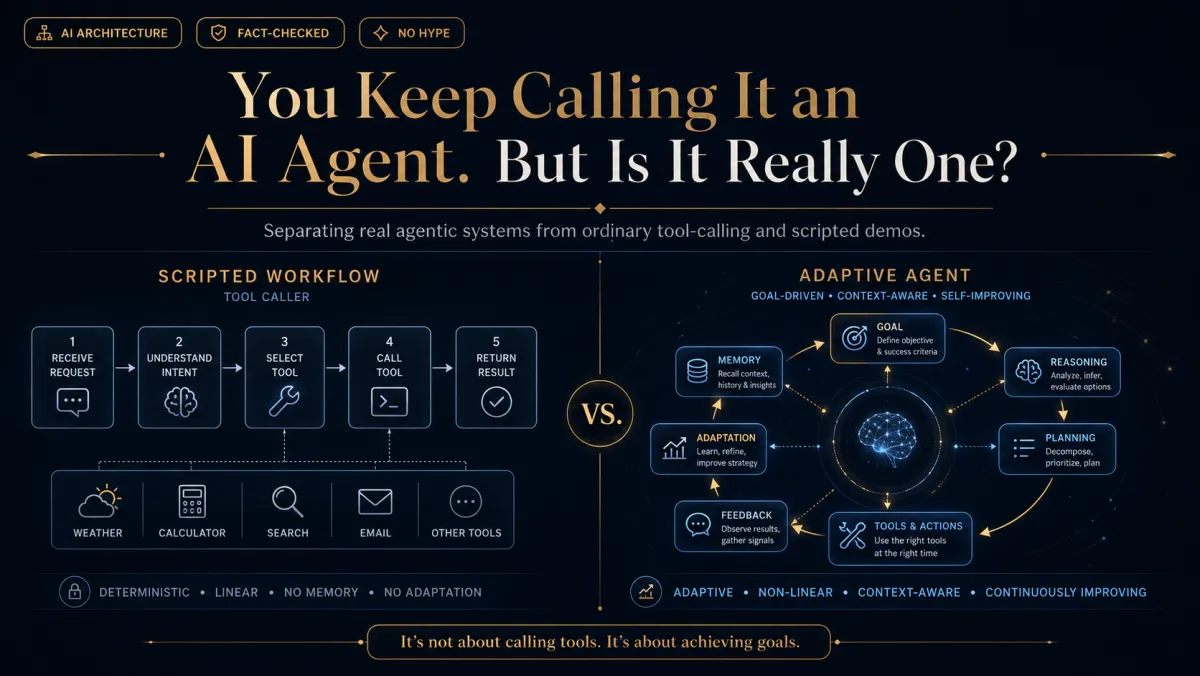
An AI agent is a goal-driven software system that uses AI to reason, plan, act, use tools, keep enough state, and adapt its next step based on feedback from the environment.
The important point: the LLM is not the whole agent. The agent is the surrounding system — the goal, state, memory, tools, policies, orchestration loop, feedback handling, approval gates, and runtime environment.
Major AI providers — Anthropic, Google Cloud, and OpenAI — converge on the same themes in their published guidance: goals, planning, tool use, state management, and meaningful autonomy. The strictest definition requires dynamic decision-making rather than a fully pre-scripted path.
Why the Confusion Is Everywhere
The market uses one word — agent — for at least four different architectures:
| What people call it | What it usually is | Example | Is it agentic? |
|---|---|---|---|
| LLM tool caller | A model selects or fills parameters for a function call. | "What is the weather in Paris?" → call weather API. | Low. Useful, but often single-step. |
| Scripted assistant | A flowchart with an LLM used for language understanding and response generation. | Collect destination, date, budget, then call flight and hotel APIs in fixed order. | Low to medium. Predictable but mostly predetermined. |
| Agentic workflow | A workflow with dynamic decisions, retries, branching, and model-driven tool selection. | Research assistant decides whether to search web, read files, ask user, or stop. | Medium. Often the best production compromise. |
| Adaptive goal-driven agent | A loop with goal persistence, memory/state, feedback handling, tool choice, and plan revision. | Plans a trip under constraints, checks calendar, compares options, adapts when prices change, asks for approval before booking. | High. Closest to true agency. |
The first two categories can deliver real business value. For many enterprise use cases, they are preferable because they are easier to test, govern, and debug. The problem starts when a deterministic workflow is sold as an autonomous agent.
A Minimal True Agent — And Why It Is Rare
Here is a small example that demonstrates the difference:
If a developer explicitly coded if API_A fails, then API_B, then search — this is still a workflow. If the system chose that recovery path from a general strategy — "use available tools, avoid failed paths, verify the result, continue until the goal is satisfied or blocked" — then it begins to look genuinely agentic.
Agency is not just "there is a loop." A loop can be dumb. Agency comes from the system's ability to choose the next step based on goal, context, state, and feedback.
The Terminator Analogy: Useful But Dangerous
The Terminator analogy actually works well as an illustration of goal persistence. The character does not follow a static script; it reacts to obstacles and keeps pursuing the objective across time and changing circumstances. One goal. Persistent pursuit. Repeated adaptation. That's the structure of a true agent loop.
But for a professional AI architecture discussion, use the analogy carefully. Enterprise AI agents should not be framed as unconstrained autonomous systems. The systems we actually want in business are bounded agents: they operate under policy, ask for approval before high-impact actions, log their reasoning and tool calls, and fail safely.
The goal is not "Terminator-level autonomy." The goal is bounded autonomy — enough flexibility to solve messy tasks, with enough guardrails to remain auditable, safe, and aligned with human intent. The Terminator had no guardrails. Your enterprise systems must.
I watched that film as a teenager and found the machine terrifying precisely because it had no off switch — no policy layer, no human approval gate, no escalation path. That is exactly what we should not build in 2026.
A Better Vocabulary for Real-World AI Systems
Instead of calling everything an agent, product teams can use clearer terms:
A model invokes one or more functions, usually within a narrow interaction. Predictable, fast, easy to govern.
A predictable workflow that uses an LLM for language, extraction, summarization, or classification within defined paths.
A goal-driven loop that plans, uses tools, tracks state, recovers from failure, and changes course based on feedback.
If you are building a tour planner that asks for destination, origin, dates, and budget, then calls APIs in a fixed order — that is a scripted assistant. It may be excellent. It may be exactly what the business needs. But it should not be described as a fully autonomous travel agent.
If the system is given a goal — "plan a birthday trip under $500 without conflicting with my meetings" — and it decides what information it needs, checks authorized tools, compares options, adjusts dates, asks for approval, and changes strategy when options fail — then the word agent starts to fit.
What Teams Should Build Instead
The honest answer: start boring. Add agency only where it earns its cost.
| Use case | Best starting pattern | Why |
|---|---|---|
| FAQ, policy Q&A, document lookup | RAG assistant | High control, lower latency, easier evaluation. |
| Invoice processing, onboarding, ticket triage | Scripted workflow + LLM steps | Clear process, predictable outcomes, easier audit trail. |
| Research, incident diagnosis, code migration assessment | Agentic workflow | Requires dynamic tool choice and plan revision. |
| High-impact actions: payments, production changes, legal decisions | Human-in-the-loop agent | Autonomy must be bounded by approvals, policy, and logging. |
For enterprise architects, the key design question is not "Do we have an agent?" It is:
Where do we need flexible model-driven decisions — and where do we need deterministic control?
That question leads to better architecture than the hype cycle does. The Terminator had one mode: pursue. Enterprise systems need many modes: pursue, pause, ask, escalate, and stop.
References
- Anthropic, "Building effective agents" — distinction between workflows and agents. Read source →
- Google Cloud, "What are AI agents?" — reasoning, planning, memory, autonomy, learning, and adaptation. Read source →
- OpenAI, Agents developer documentation — agents plan, call tools, collaborate, and keep state for multi-step work. Read source →
- MineDojo/Voyager, "An Open-Ended Embodied Agent with Large Language Models" (2023) — NVIDIA, Caltech, Stanford, UT Austin. Read source →
- The Terminator (1984), dir. James Cameron — verified release date October 26, 1984 via IMDB and AFI Catalog. IMDB →